
Understanding Common Bottled Water Sizes
The 8-Ounce Mini Bottle
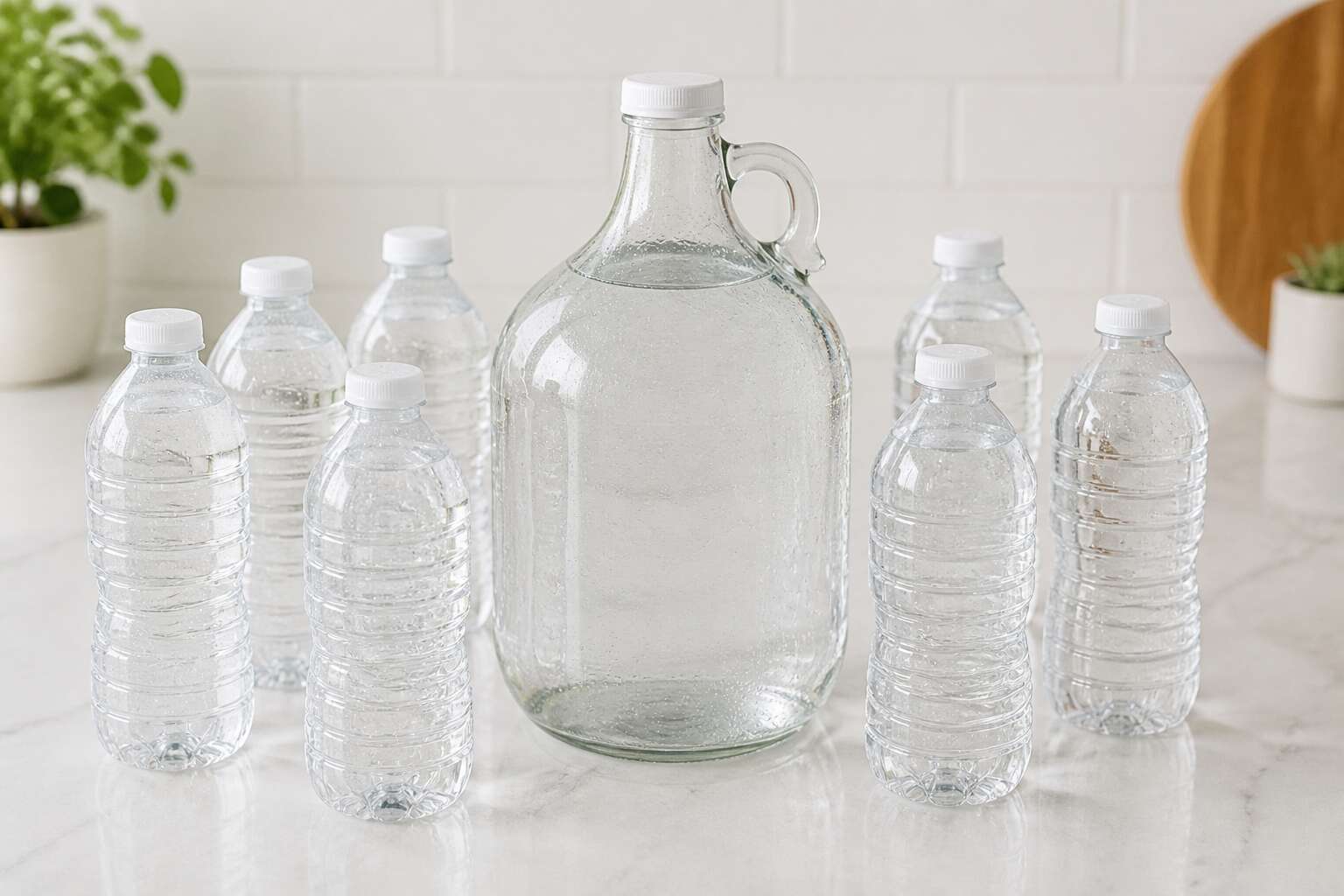
When we speak of the 8 ounce mini bottle, we are speaking of a tiny vessel that holds a single modest gulp. In fact, eight ounces is precisely one cup. To answer how many bottled water make a gallon, this small format requires the most arithmetic. A standard gallon holds 128 ounces. That means you would need 16 of these miniature bottles to fill one gallon container.
These bottles are common in bulk packs and lunchboxes. They are not practical for daily hydration on a larger scale. However, their small volume makes them a useful measuring stick. When you see a pack of 24, you can quickly note that this is one and a half gallons worth of water. Understanding this ratio helps you visualise how many bottled water make a gallon without touching a calculator.
The 12-Ounce Standard Bottle
The 12-ounce standard bottle sits between the diminutive 8-ounce cup and the larger sports vessels. It is the default in vending machines and six-pack carriers. When calculating how many bottled water make a gallon, this size presents a fractured answer. A gallon demands 128 ounces. Twelve divides into that total ten times, with eight ounces left over. Therefore, you need ten whole bottles plus two-thirds of another to complete the gallon. That partial bottle creates a minor inconvenience for anyone tracking intake precisely.
People often buy these bottles believing they are managing their hydration, yet the math reveals a recurring shortfall. You drink two and remain thirsty for a third. The 12-ounce bottle is a compromise, not a measure. Its popularity stems from portability, not precision.
The 16.9-Ounce Half-Liter Bottle
Walk into any spaza shop in Limpopo or a supermarket in Sandton, and the 16.9 ounce half liter bottle dominates the shelf. It is the workhorse of the bottled water industry, the size most South Africans reach for without thinking. The number itself looks odd, 16.9 ounces, until you realise it is simply 500 milliliters dressed in imperial clothing.
For anyone asking how many bottled water make a gallon, this bottle delivers the most satisfying answer. A gallon contains 128 ounces. Divide that by 16.9, and you land at 7.57 bottles. Seven and a half bottles, roughly, to reach the mark. I find that half bottle reassuring. It means you are never far from a full gallon, even when you are just sipping through a normal day.
The 20-Ounce Sports Bottle
The 20 ounce sports bottle is a different creature. It is built for motion, for the treadmill at Virgin Active or the trail up Table Mountain. The wider mouth accepts ice cubes and the squeeze mechanism rewards effort.
When you ask how many bottled water make a gallon, the 20 ounce bottle returns 6.4 bottles. That decimal point is the problem. You cannot drink four tenths of a bottle without looking obsessive. Six bottles leave you short by nearly half a litre.
This bottle forces a decision:
- Drink a seventh bottle and exceed the gallon
- Stop at six and accept the shortfall
Most people stop. I have never once finished a gym session and thought about gallons. The sports bottle handles hydration during a session, but it is a poor ruler for measuring one.
The 1-Liter Large Bottle
The 1 Liter Large Bottle: This is the bottle you keep on your desk when you are serious about finishing the day without a headache. It has none of the sports bottle’s squeeze mechanism, no need for a steady hand on a treadmill. It simply sits and waits. When we ask how many bottled water make a gallon, the 1 liter bottle answers with 3.8 units, a quieter decimal than the 20 ounce version but one that still refuses to land cleanly. Three liters leaves you 500 millilitres shy of the mark, and four liters pushes you past the gallon with roughly 200 millilitres to spare.
Most people drink three liters and accept the shortfall. The more precise drinker finishes the fourth bottle and treats the surplus as a harmless accident. This is the only format that makes the gallon feel reachable, because the numbers sit close enough to the imperial target to stop being a puzzle. It is also the only common bottle that aligns with the metric system South Africans use every day. So when you ask how many bottled water make a gallon, the 1 liter bottle is the closest thing to a comfortable answer.
The Simple Math Behind Bottles and Gallons
Fluid Ounces in a US Gallon
One hundred and twenty eight. That is the number of fluid ounces in a US gallon, a figure that has tripped up many a mathematically inclined thirst quencher. The imperial gallon, which some South Africans recall from older cookbooks, holds a more generous 160 ounces. This distinction matters when you ask how many bottled water make a gallon.
The calculation is simple. Take your bottle size, divide it into 128, and there you have it. The answer changes with each container you grab from the fridge. Smaller bottles demand more effort, while larger ones close the gap in fewer steps.
Here is the practical takeaway:
– A gallon is a fixed target.
– Your bottle is the measuring stick.
– Division is the only tool required.
Once you understand this arithmetic, the number of bottles needed is your choice. That is the whole answer to how many bottled water make a gallon.
Calculating Bottles per Gallon with a Basic Formula
The arithmetic behind this question is refreshingly simple. A US gallon holds exactly 128 fluid ounces. That fixed figure is the only constant you need, and your bottle size becomes the divisor. Divide 128 by the ounces in your container, and the quotient tells you precisely how many bottled water make a gallon. No rounding, no guesswork.
Consider the operation itself. Every bottle size yields a different answer, but the formula never changes.
1. Identify the bottle’s volume in ounces.
2. Divide 128 by that number.
3. Read the result as bottles per gallon.
That mechanical process works for any vessel you own. The imperial gallon, at 160 ounces, uses the same logic. Once you grasp this ratio, the question of how many bottled water make a gallon becomes a matter of simple division. You are the one who picks the bottle. The math stays steady.
Working with Liter-Based Bottles
Nearly 80% of South African households buy water in liter-based packaging, yet most owners cannot tell you the exact gallon equivalence. The metric system does not play nicely with imperial units, which explains the confusion. A 500ml bottle, the most common size in local stores, does not hold 16.9 ounces as most assume. It holds 16.9 ounces only if you round up. The precise figure is 16.907, which changes your division slightly.
– A 500ml bottle requires 7.57 bottles to reach a gallon.
– A 750ml bottle requires 5.05 bottles.
– A 1.5L bottle requires 2.52 bottles.
You simply convert the liters to ounces first. One liter equals 33.814 ounces. Multiply that by your bottle volume, then divide 128 by the result. The math remains straightforward. The label is your best friend here, as it states the exact volume in both systems.
The 500ml bottle creates the most confusion because people round down to 16 ounces. That rounding error means you end up short by half a bottle. For those asking how many bottled water make a gallon, the label gives the only honest answer.
Quick Reference Chart for Popular Sizes
The label holds the only honest answer, but the arithmetic behind it is simpler than most imagine. A US gallon contains exactly 128 fluid ounces. Divide that by the bottle volume printed on the side. That single calculation settles how many bottled water make a gallon for any package you pick up. For quick reference, the common sizes resolve to these numbers:
- 8 ounce mini bottle: 16 per gallon
- 12 ounce standard: 10.67 per gallon
- 16.9 ounce half liter: 7.57 per gallon
- 20 ounce sports bottle: 6.4 per gallon
- 1 liter large bottle: 3.79 per gallon
The list above covers the packaging found in most South African stores. Remember that rounding creates drift. A half liter bottle often rounds to 16.9 ounces, yet the exact volume shifts the count slightly. When someone asks how many bottled water make a gallon, hand them this chart and the answer becomes immediate.
Why the 16.9-Ounce Bottle Is the Industry Standard
The Global Half-Liter Packaging Norm
While environmental purists might mourn the plastic, the 500-millilitre bottle, which is 16.9 ounces, is the undisputed king of the cooler. It is the global default for a reason. The transition to metric sizing in the late 20th century gave manufacturers a clean, round number for international trade. A full litre is simply too heavy for a casual swig, and the 500ml offering provides a satisfying gulp without committing you to a bathroom break in the next hour.
The industry latched onto this volume because it balances manufacturing efficiency with consumer expectations. This specific size fits neatly into standard cup holders, vending machines, and lunchboxes. It also simplifies logistics, as 16.9 ounces represents a perfect half of a standard US liquid quart, making import and export calculations for companies easier when dealing with American partners.
Consider a few standard environments where this sizing dominates:
– Hotel room mini bars
– Airport convenience kiosks
– Corporate meeting room catering
– Gym vending machines
The ubiquity of this size means consumers rarely have to calculate how many bottled water make a gallon when grabbing a quick drink. The psychological pricing point also plays a role, as the bottle feels substantial enough to justify its price, yet light enough to carry all day. It is the Goldilocks zone of hydration, truly the global median.
Convenience and Portability Factors
Few people pause to consider how many bottled water make a gallon when grabbing a 16.9 ounce bottle. The number, 7.57 bottles, matters less than the feel of the object. This bottle fits a car cup holder, slips into a backpack side pocket without bulging, and survives a commute without leaking.
Portability drives the standard. A 500 millilitre container weighs roughly 500 grams when full. That weight suits a walk across Johannesburg or a long flight from Cape Town. I have carried one through both. Manufacturers appreciate the uniformity, since the same mould works for every market.
- Standard airline tray tables accommodate the base
- Gym equipment racks have holders designed for this diameter
Convenience becomes habit. Once the 16.9 ounce size dominates shelves, retailers, distributors, and consumers all default to it. The question of how many bottled water make a gallon becomes arithmetic rather than a shopping decision.
Marketing and Consumer Perception
The 16.9 ounce bottle persists because marketing shaped perception before arithmetic could intervene. When a shopper asks how many bottled water make a gallon, the question arrives after years of seeing this bottle on every shelf and in every cooler. The answer matters less than the reflex.
The number 16.9 carries peculiar authority. It suggests precise measurement, a serving engineered by experts. Half a litre looks like a complete transaction. You finish it, discard it, and move on. That closure satisfies.
Retailers appreciate the size because it commands a price that feels incidental. Consumers trust the shape they have trusted for decades. Marketing built that trust through ubiquity, not argument. I have watched buyers in Johannesburg grab the familiar bottle without a glance at alternatives. They never pause to ask how many bottled water make a gallon. The question is irrelevant to the habit.
Real-World Scenarios for Estimating Your Intake
Meeting Daily Hydration Recommendations
On a sweltering Johannesburg afternoon, your body signals thirst long before your mind acknowledges it. Estimating how many bottled water make a gallon becomes a dry arithmetic you cannot ignore. The standard half-litre bottle disappears in three gulps while you sit in traffic.
Consider a working day. You finish one bottle with your morning coffee. Another sits in your car. A third disappears during lunch. Without conscious effort, you have consumed less than a litre. The daily hydration recommendation of roughly two litres for adults slips away in this manner. Knowing how many bottled water make a gallon helps you judge whether your afternoon refill pattern actually meets your target.
Planning for a Week of Hydration at Work
Picture the office fridge in Sandton on Monday morning. It holds seven half-litre bottles, your intended supply until Friday. By Wednesday, you have already raided the vending machine twice. That is when the arithmetic of how many bottled water make a gallon stops being theory!
I keep a permanent marker on my desk. Each bottle gets a tick when emptied. A full work week demands roughly 6.8 half-litre bottles to equal one US gallon. My actual consumption lands closer to four.
- Monday: two bottles before lunch
- Tuesday: one bottle, forgotten in the car
- Wednesday: three bottles, stress related
The gap between intention and behaviour becomes visible when you track the week. The gallon figure gives you a fixed number to measure against.
Calculating Bottles for a Weekend Camping Trip
Packing for a weekend at Augrabies Falls demands a different kind of discipline. The campsite has no filtered taps near the pitches, so all water travels with you. Saturday morning, I lined up bottles on the picnic table and counted. The question of how many bottled water make a gallon becomes practical when you are loading a backpack rather than opening a fridge.
I planned for two people over three days:
- Two half-litre bottles per person for drinking each day
- One bottle per meal for cooking or coffee
- Two emergency bottles kept in the car boot
That added up to 18 bottles, roughly 2.1 gallons. The weight came to 9 kilograms. By Sunday evening, we had used every drop except the car emergency stash. The gallon figure helped me pack precisely, nothing more, nothing less.
Understanding Bulk Purchases for Events
Planning a ten kilometre run through the Magaliesberg demands more than self discipline, it demands arithmetic. Ask any event organiser in Johannesburg about the question of how many bottled water make a gallon and they will tell you that the answer decides whether your afternoon ends in comfort or chaos.
For a short group hike, I calculate two half-litre bottles per person for drinking and one for hydration on the trail. That works out to about 0.8 gallons per person. For forty guests at a weekend market stall or a birthday party, you multiply by the crowd. A simple approach:
1. Assume one litre of water per guest over five hours.
2. Convert that litre estimate into gallons.
3. Divide the gallon total by the volume of a single bottle.
The result gives you the exact number of bottles to order. I remember under ordering for a school fundraiser because I forgot to convert litres to gallons. That mistake left me with a queue of thirsty parents.
Environmental and Cost Considerations Beyond the Math
Plastic Waste Generated per Gallon Consumed
When asking how many bottled water make a gallon, the answer is about eight half-liter bottles. But the arithmetic misses the environmental ledger. Each of those eight bottles represents roughly 100 grams of PET plastic, a material that takes centuries to degrade. South Africa recycles about 60 percent of its PET, yet the remaining fraction ends up in landfills or waterways.
Consider the inputs for a single gallon:
- Eight bottle caps, each requiring its own moulding process.
- Eight labels and their adhesives, often mixed-material waste.
- Shipping weight that nearly doubles with packaging included.
The cost also compounds. Paying for bottled water at roughly R15 per litre means a gallon costs over R50, while tap water costs a fraction of a rand. The plastic waste per gallon consumed becomes a recurring expense, both financial and ecological. For households relying on bottled water, that adds up to thousands of bottles annually.
Cost Comparison: Bottled Water vs. Tap Water
Understanding how many bottled water make a gallon is the easy part. The harder question involves what that gallon costs beyond the shelf price. In South Africa, bottled water at around R15 per litre makes a single gallon roughly R55. Municipal tap water costs fractions of a cent per litre. That means bottled water commands a premium of over a thousand times.
The environmental side repeats that pattern. Eight bottles require petroleum for the plastic, fuel for the shipping, and energy for the refrigeration at every stop. Each bottle also needed water in its manufacturing process. I find that figure surprising: producing one gallon’s worth of bottles can consume up to three litres of water.
- Tap water arrives through existing pipes with minimal added packaging.
- Bottled water adds label, cap, and adhesive waste per unit.
The difference between tap and bottled water, measured against the question of how many bottled water make a gallon, becomes a calculation of value rather than volume.
Reusable Bottles as a Practical Alternative
When you ask how many bottled water make a gallon, the answer is eight half-liter bottles. But the real cost of those eight bottles extends well beyond the shelf price. In South Africa, that gallon costs around R55 in bottled form, while tap water arrives for fractions of a cent. The premium is stark, and I find it worth pausing over.
Reusable bottles shift the equation entirely. One durable bottle replaces hundreds of plastic units, cutting the petroleum, shipping fuel, and manufacturing water that each single-use bottle demands. For a household, the savings accumulate quietly with every fill.
Reducing Your Single-Use Bottle Footprint
In South Africa, the answer to how many bottled water make a gallon is statistically simple, yet the true ledger is written in water and electricity. Each half-liter bottle requires roughly three times its volume in water to produce the plastic itself. A single gallon of bottled water therefore contains a hidden reservoir of nearly twenty-four liters of manufacturing water. This is the unseen currency of convenience.
The cost of this extraction is compounded by the energy load. Consider what is required for that one gallon:
– Plastic resin derived from fossil fuels
– Energy for molding, filling, and capping
– Fuel for refrigerated transport
– Water used in the washing and cooling processes
The economic weight of these factors is rarely visible on a till slip. Consumers pay for the bottle, but the environment pays for the entire industrial ballet. When considering your daily gallon, the externalized costs become a public burden, drawn from municipal water systems and power grids that are already under strain. Our infrastructure carries the true price of every disposable sip.
0 Comments