
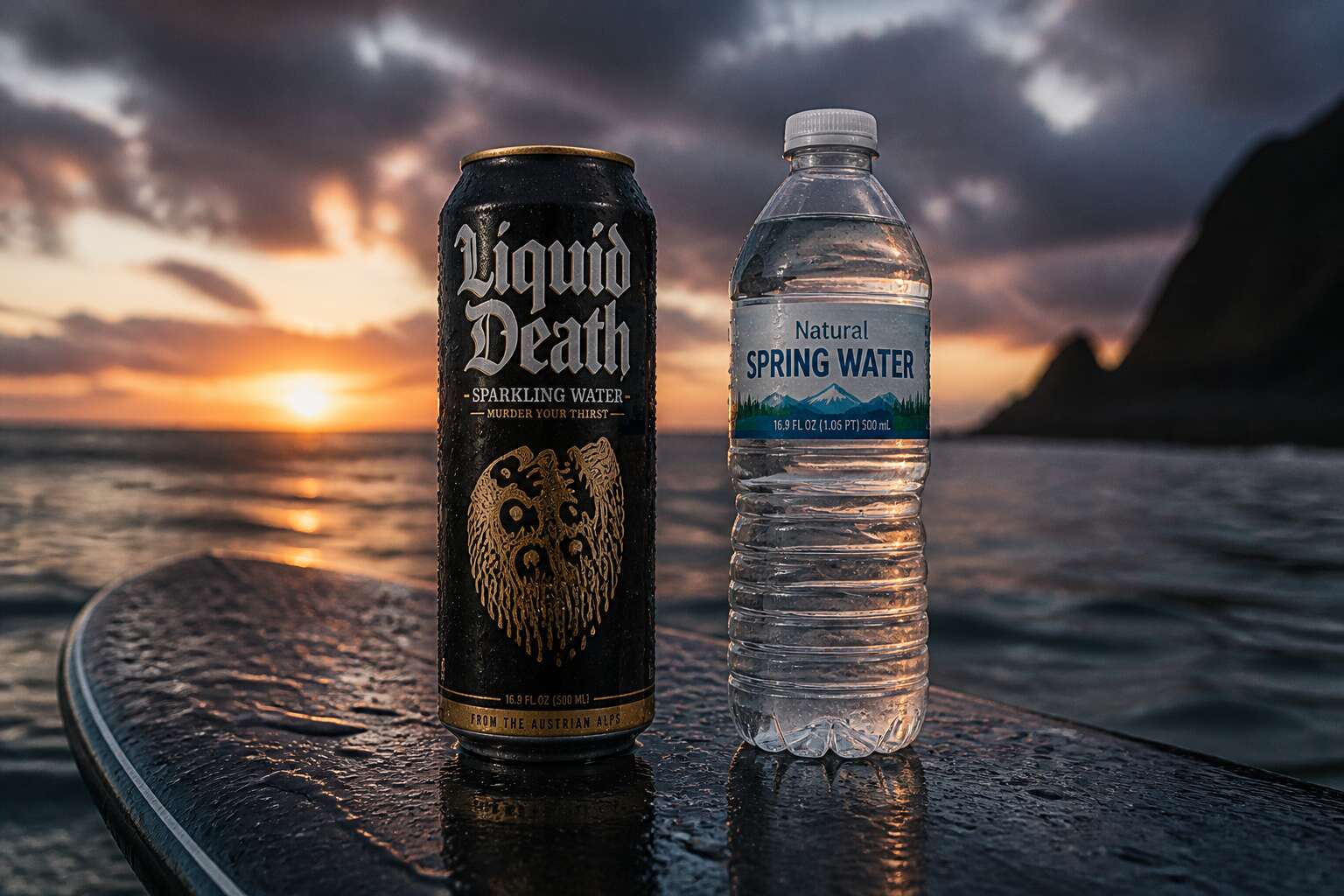
Liquid Death and Bottled Water: Key Differences
What Is Liquid Death?
A can of Liquid Death looks like a concert poster, not a hydration tool. That visual contrast sits at the heart of the liquid death vs bottled water comparison. Where bottled water leans on purity imagery, Liquid Death embraces heavy metal bravado. It is still water from alpine springs, but it comes in tallboy cans and donates profits to plastic removal efforts.
What is Liquid Death? It is a brand that treats water as a rebellious character. The product offers still and sparkling varieties, each filtered and supplemented with minerals for a smooth mouthfeel. The packaging is 100% recyclable aluminium, a direct counterpoint to single-use plastic bottles.
Key differences appear quickly:
- Container material: aluminium versus plastic
- Marketing tone: irreverent versus wholesome
- Environmental angle: recycling push versus general sustainability
Regular bottled water tries to be invisible; Liquid Death demands attention. Both hydrate, but they target different audiences.
Understanding Bottled Water
Liquid death vs bottled water forces a closer look at why we choose what we drink. Bottled water sells sameness, a neutral promise of safety. Liquid Death sells confrontation, a can that demands attention. The real difference lies in the relationship you build with the package, not in the water itself. I see it as a rebellion against the blandness of hydration!
- Aluminium cans cool faster and stay colder than plastic bottles.
- Plastic bottles dominate retail shelves, while cans capture attention in a cooler.
- The price point for Liquid Death often exceeds standard bottled water.
Understanding bottled water means seeing it as a default option. In the liquid death vs bottled water debate, most brands rely on glacial imagery and reverse osmosis claims. Liquid Death uses the same alpine source but reframes the ritual. That shift changes the perceived value, not the hydration outcome.
Brand Positioning and Marketing
Most water brands sell purity. Liquid Death sells irreverence. That distinction shapes every marketing decision, from label design to shelf placement. The liquid death vs bottled water competition is not about hydration. It is about identity.
Bottled water marketers emphasize alpine springs and reverse osmosis. Liquid Death emphasizes punk aesthetics and dark humor. The brand positions itself as a beverage for people who find traditional water advertising dull. It uses tallboy cans, aggressive typography, and a name that forces a second glance.
Consider the practical differences:
– Price is often higher for Liquid Death than standard bottled water.
– Cans cool faster and stay colder, while plastic bottles dominate retail shelves.
– Bottled water targets a broad audience; Liquid Death targets style conscious drinkers.
Neither approach changes the water itself. The positioning does the work.
The Core Differences at a Glance
Bottled water has a packaging problem that no marketing campaign can fix. A plastic bottle takes centuries to break down. An aluminium can returns to the recycling loop in weeks. That single fact drives most of the liquid death vs bottled water debate among South African drinkers.
But the differences run deeper than decomposition timelines. Cans cool faster on a Durban afternoon, and I’ll take that over a lukewarm bottle every time. Bottles are easier to crush and stash in a car door. Aluminium doesn’t leach flavour into the water; plastic sometimes does. Neither option changes the H2O itself, but the experience of drinking it shifts.
The practical comparison:
- Liquid Death cans weigh less per litre than glass bottles.
- Plastic bottles are cheaper to produce and distribute.
- Cans fit vending machines and cooler boxes better.
- Bottles still dominate the township spaza shop shelf.
Environmental Footprint: Packaging and Sustainability
Aluminum Cans vs. Plastic Bottles
Consider the humble can versus the plastic bottle. In the liquid death vs bottled water debate, packaging often decides the eco-warrior’s loyalty. Aluminum offers a closed loop, and South Africa’s recycling rate for beverage cans outpaces that of plastic. Yet the carbon cost of mining and refining bauxite is no small matter.
Here is what separates the materials:
- Aluminum reprocessing uses roughly 5% of the energy needed for primary production, making recycling highly efficient.
- Plastic bottles require less energy to manufacture but lose integrity after a few cycles, often ending up as synthetic fabric or landfill.
The satirical twist is that consumers often choose a can for its aesthetic while ignoring the logistics. A greener choice depends on whether your neighbourhood actually recycles, not on which brand looks more virtuous.
Recycling Rates and Lifecycle Analysis
South Africa recovers about 68% of PET bottles, but 32% slips through. In the liquid death vs bottled water debate, the packaging that looks greener on a shelf may not survive the local waste flow. Collection rates are not uniform. They swing with infrastructure, with weather, with the price of recycled resin.
These variables make a blanket verdict impossible. Consider three hidden costs I rarely see quoted:
- The diesel burned by refuse trucks on a dedicated collection route.
- The water used in a sorting plant to clean each bale.
- The methane released when a bottle rests in a landfill instead of a recovery facility.
Each of these factors shifts the environmental footprint more than branding ever could. Sustainability in this context is a systems audit. When you weigh liquid death vs bottled water, you weigh two supply chains with divergent energy paths. A lifecycle analysis that ignores the local recycling rate is incomplete!
Carbon Footprint Comparisons
Most consumers assume thinner packaging means a lighter footprint. The carbon data disagrees! Aluminum smelting runs on electrolysis at colossal temperatures, so a 500ml virgin can emits about 200g CO2e. A PET bottle of the same size stays near 100g.
This is where the comparison gets uncomfortable. The carbon burden shifts from factory to logistics. Heavy aluminum trucks burn more diesel per kilometre than plastic cases. A packed pallet of cans outweighs a pallet of bottles by three times.
- Virgin aluminum: double the CO2 of plastic.
- Recycled aluminum: minimal energy, but few can banks exist.
- Road distance shifts the carbon footprint.
South Africans traverse long supply routes. Comparing liquid death vs bottled water, the diesel burned on the N3 often outweighs the material difference.
Waste Management and Landfill Impact
Roughly 90% of South Africa’s waste ends up in landfill, one of the highest rates in the developing world. That statistic reshapes the liquid death vs bottled water debate. The deciding factor is what happens after disposal.
In a landfill cell, the two materials behave differently:
- PET bottles fragment into microplastics, which migrate into surrounding soil and water.
- Aluminum cans resist breakdown and remain as intact scrap for centuries.
South Africa’s informal waste economy complicates the comparison. Waste pickers pull aluminum cans from landfill sites because scrap yards pay meaningful rates. Those cans often re-enter production cycles. PET bottles fetch weaker prices at buyback centres, so more of them remain buried permanently. Walk a municipal landfill cell in Gauteng and you will see more PET than aluminum. That gap defines the packaging choice for South African municipalities.
Health and Hydration: What’s Inside
Mineral Content and Purity
Water is rarely just water. The mineral content in the liquid death vs bottled water debate reveals how source and process shape every sip. Liquid Death begins as alpine spring water, undergoes purification, then receives sodium bicarbonate and potassium chloride for balance. Most bottled waters offer a different equation entirely. Some spring varieties carry calcium and magnesium naturally. Others, like purified options, arrive stripped of minerals and may taste flat.
Consider the mineral profiles across common South African brands:
- Spring water: calcium and magnesium from natural aquifers, varying by rainfall.
- Purified water: minerals removed, sometimes added back for flavor.
- Liquid Death: consistent sodium and electrolytes from controlled re-mineralization.
The purity story matters equally. Liquid Death filters to a consistent standard, while natural spring claims can shift with the season. I appreciate that Liquid Death publishes its full mineral panel, something many bottled water labels avoid.
pH Levels and Electrolytes
pH levels separate these contenders in measurable terms. Liquid Death maintains a steady 8.0, mildly alkaline from added sodium bicarbonate. Most bottled water lands between 6.5 and 7.5, though South African spring varieties can shift with seasonal rainfall.
Electrolyte content follows a different logic. Liquid Death receives deliberate additions of potassium chloride and sodium for consistent balance. Many bottled waters rely on whatever minerals the aquifer provides. Some contain almost none.
- Sodium supports fluid balance during strenuous activity.
- Potassium regulates nerve signals and muscle contraction.
- Calcium and magnesium appear naturally in hard spring water.
In the liquid death vs bottled water comparison, the real question is whether you prefer engineered consistency or natural variability. Both approaches carry trade-offs.
Taste and Mouthfeel Analysis
The sensory experience separates these two drinks more than any label claim. Open a can of Liquid Death and you notice the weight first. The aluminum conducts temperature rapidly, keeping the water bitingly cold. The mouthfeel is substantial, almost heavy, because the added minerals give it structure. Bottled water feels thinner by comparison. Many South African spring waters share that light, fleeting texture.
Taste tells the real story. Liquid Death has a distinct mineral finish, a deliberate salinity that lingers on the tongue. It tastes engineered, because it is. Most bottled waters aim for neutrality, a clean swallow that leaves nothing behind. Some South African varieties from the Cape regions carry a faint earthiness, a result of granite and sandstone aquifers.
I notice the difference most during a hot afternoon. The canned water feels like a tool. The bottled water feels like refreshment. Neither is wrong, but the choice affects how you experience hydration.
Here is what to expect depending on your source:
1. Spring water moves through geological layers, collecting dissolved solids along the way.
2. Purified bottled water goes through reverse osmosis or distillation, stripping nearly everything away.
3. Liquid Death starts with municipal water, filters it, then adds specific minerals back in measured amounts.
4. Artisanal South African waters often skip re-mineralization entirely, trusting the source.
The liquid death vs bottled water comparison comes down to intentionality versus nature. One delivers a predictable product every single time. The other varies from batch to batch, season to season. If you want consistency, the can wins. If you want a sense of place, bottle it.
Health Claims and Labeling
Most drinkers never read the fine print. Labeling is where the industry separates theatre from fact. Liquid Death states its mineral profile openly, listing added magnesium and calcium after filtration. That transparency is rare. Meanwhile, bottled water brands lean on terms like “pure” or “natural,” which have no fixed legal meaning in South Africa. The source dictates the truth.
The health claims deserve scrutiny. Some waters promise “alkaline balance” or “electrolyte enhancement” without specifying amounts. For the liquid death vs bottled water decision, check the label for sodium content. The canned product adds sodium bicarbonate, which raises intake slightly. Spring water carries whatever the rocks gave it. Look for these markers:
- Total dissolved solids listed in mg/L
- pH value and testing method
- Actual source location, not a brand name
I trust numbers over adjectives. One label reports, the other implies.
Cost and Convenience: Making a Choice
Price Per Liter: A Direct Comparison
R35 for a can of water sounds absurd, but that is the price for Liquid Death in Johannesburg. Compare that to a 500ml plastic bottle of local spring water at R9, and the per liter math becomes brutal. Liquid death vs bottled water is essentially a premium of 300% for the same hydration.
- Liquid Death: R70 per liter
- Standard bottled water: R18 per liter
Convenience reinforces the gap. Cans dent easily, weigh more, and take up extra space in a cooler. Plastic bottles crush down and fit everywhere. For hikers or commuters, that difference matters daily. So when I weigh cost and convenience, that premium offers no practical argument.
Availability and Retail Distribution
Walking into a Johannesburg Woolworths or premium grocer, you might spot Liquid Death between craft sodas and imported energy drinks. That is the extent of its retail footprint in South Africa. Standard bottled water, by contrast, sits on shelves in every petrol station, corner cafe, and township spaza shop from Sandton to Soweto.
Availability shapes habit. When a product requires a deliberate trip to a specific store, it becomes a special purchase, not a daily staple. The distribution gap in the liquid death vs bottled water comparison reinforces the choice:
- Liquid Death appears in select urban retailers with limited stock
- Bottled water exists in over 90% of South African convenience outlets
- Online delivery for Liquid Death adds fees that widen the cost gap
For most South Africans, liquid death vs bottled water is settled before the taste debate begins. One product is everywhere; the other demands a planned stop.
Serving Size and Portability
Holding a cold can of Liquid Death feels solid, but that weight becomes a penalty. A 500ml aluminum can weighs around 150 grams, while a similar plastic bottle weighs half that. For a hiker on Table Mountain or a commuter on the Gautrain, the extra grams matter.
Then there is the cost of convenience. When you buy liquid death vs bottled water, you pay for the can, the brand, and the delivery if you order online. A bottle of water from a spaza shop costs R10 and fits in your hand. The can needs a bag, a cooler, or a planned stop.
- Serving size: Liquid Death offers 500ml cans; bottled water ranges from 330ml to 5 litres
- Portability: Plastic bends and compresses; aluminum dents and stays rigid
That rigidity makes the can awkward in a car cup holder or a school lunchbox. The liquid death vs bottled water decision becomes a matter of what you can carry, not what you crave. The can does not crush easily. It sits there, patient, as if waiting for you to admit that you bought it for the image, not the water.
Consumer Demographics and Preferences
The water aisle is a demographer’s delight. The liquid death vs bottled water choice separates two types of shoppers. One group buys a can to display an identity. The other group buys a bottle to satisfy thirst.
Convenience follows these identities. The can now appears in boutique gyms, co-working spaces, and tech offices. The bottle is found at taxi ranks, school tuckshops, and family dinners. Each channel reinforces the habit.
- The can buyer plans ahead, often ordering online by the case.
- The bottle buyer acts on impulse, grabbing one from a spaza shop.
Cost is a filter. The can’s premium is part of its appeal. The bottle’s low price is its own reassurance.
Subscription and Bulk Purchasing Options
Subscription models have changed how South Africans buy water. Liquid Death offers direct-to-consumer cases, delivered on a schedule. The pricing rewards commitment, dropping per-can cost by roughly 15% when you subscribe. Bottled water brands rarely offer this. Bulk purchasing means a trip to Makro or Game.
The convenience gap runs deeper. A subscription removes decision fatigue. The cans arrive whether you remember or not. Bulk bottled water purchases require storage space and planning, though the per-liter price dips.
Let me give you the local numbers:
- A 24-pack of Liquid Death costs around R600, or R25 per can
- A 24-pack of still bottled water costs around R150, or R6.25 per bottle
- Subscription discounts drop Liquid Death to roughly R21 per can
The liquid death vs bottled water cost calculation becomes a commitment test. The subscription route suits a planned lifestyle, while the spaza shop bottle suits a spontaneous one.
Which Option Aligns With Your Values?
Assessing Your Hydration Needs
Most people grab whichever bottle is closest. That approach ignores a simple truth. Your hydration needs reflect your lifestyle, not simply your thirst. When you assess liquid death vs bottled water, consider what you actually value. This decision goes beyond quenching a craving. It is a personal compass check.
Do you prioritize long-term sustainability or immediate convenience? Do you need electrolyte replenishment after exercise or pure H2O for daily desk work? These answers shape the better choice. No single product fits every person. Your body’s demands change with heat, humidity, and activity levels.
A quick self-check helps:
- Daily activity level
- Local water quality
- Storage and carrying habits
The right option matches your routine, not a marketing slogan. That is the only standard that matters.
Weighing Environmental Priorities
Your values determine which container you can live with. The liquid death vs bottled water choice asks you to rank your environmental priorities, not to find a universal truth. In South Africa, municipal waste systems differ by region. A can might be recycled effectively in Cape Town but end up in a private landfill elsewhere.
Think about your own habits. Do you buy one bottle per week or one per day? That frequency changes the equation. Aluminium’s energy cost makes sense only if that can returns to the cycle. Plastic’s low production weight loses when it gets incinerated or dumped.
- Ask your local municipality about their recovery rates
- Observe whether your street has separate recycling bins
- Track how often you actually refill versus toss
This isn’t about absolute good or bad. It is about matching your purchase to the system around you.
Budget Considerations
When you weigh liquid death vs bottled water, your wallet often speaks louder than your ideals. In South Africa, the price gap is real. Canned water costs more per liter than a standard plastic bottle. That difference adds up if you buy daily.
Budget forces a closer look at your habits. I have seen shoppers grab a can for the novelty, then switch back when the till total jumps. Ask yourself: can I sustain this extra expense for a cause?
- Reusable bottle: cheapest long term.
- Plastic bottle: lower upfront cost per unit.
- Aluminum can: premium price with a lighter footprint.
Your values decide if that premium is worth it. If money is tight, bottled water wins on sheer arithmetic. But if you value recycling infrastructure, the can may justify itself.
The Verdict: Selecting Your Everyday Water
Most South Africans buy water daily, yet few pause to examine what that purchase declares. The question of liquid death vs bottled water extends beyond hydration; it aligns your everyday habit with your deeper convictions.
One shopper chooses the can for its environmental stance, accepting the higher price as a form of advocacy. Another picks the plastic bottle because the math works for a tight month. These are not competing truths, they are parallel realities.
- Does the can’s rebellion match your worldview?
- Does the bottle’s practicality serve your daily rhythm?
The verdict rests on which trade off you can live with. There is no universal winner here, only a personal reconciliation between your values and your reality.


0 Comments